





A customer receives an email that looks exactly like it came from your billing team. The logo is correct, the tone matches, even the footer links resolve somewhere. Except none of it originated from your organization. This is the kind of moment BRM exists to prevent, and it happens more often than most security budgets account for.
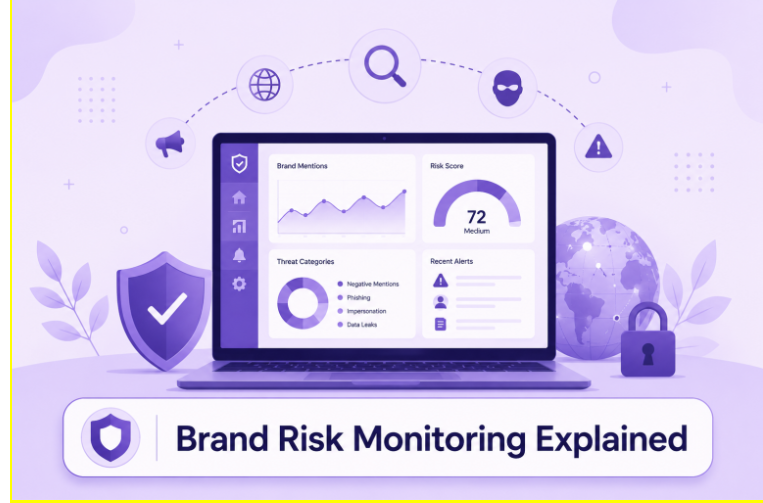
Brand Risk Monitoring, or BRM, is the practice of tracking how a company’s identity, name, logo and digital assets are used or misused across the internet. It covers fake domains, cloned websites, impersonation on social platforms and mentions of stolen credentials on forums that never make it to a standard vulnerability scan. Traditional perimeter security was never built to watch what happens outside the perimeter. BRM fills that gap by treating brand reputation as an asset that needs continuous surveillance instead of occasional PR attention.
What Falls Under Brand Risk Monitoring
This kind of program is not a single tool bolted onto existing defenses. It combines domain intelligence, social media scanning, dark web monitoring and takedown coordination into one continuous workflow. Microsoft, Google and Amazon collectively account for nearly three quarters of typosquatting-based phishing domains recorded through mid-2026, which shows how quickly a recognizable brand becomes raw material for attackers. Smaller and regional brands are not spared either, they are simply targeted with less media attention when it happens.
Executives are impersonated on LinkedIn to run fraudulent job offers. Customer support handles are cloned on social platforms to intercept complaints and harvest payment details. Fake mobile apps carrying a company’s branding appear on unofficial stores within days of a genuine product launch. None of these incidents touch internal infrastructure, which is exactly why they slip past conventional monitoring.
Why This Sits Outside Traditional Security Tooling
Firewalls, endpoint detection and SOC monitoring protect what an organization owns and controls. This kind of monitoring protects what an organization cannot directly control but is still held accountable for, its public identity. A lookalike domain registered by a criminal group sits entirely outside a company’s network, yet the financial and reputational fallout from a successful scam lands squarely on the impersonated brand.
The Core Components of a BRM Program
A functioning setup like this is built from a handful of interlocking capabilities rather than one piece of software. Before listing them, it helps to picture how they connect: detection feeds intelligence, intelligence drives prioritization and prioritization determines which takedowns happen first.
- Domain and Typosquat Monitoring: Continuous scanning for lookalike domains, homoglyph registrations and newly issued certificates tied to brand keywords.
- Social Media Impersonation Detection: Identifying fake profiles, cloned pages and fraudulent ad campaigns running under a company’s name.
- Dark Web and Forum Surveillance: Tracking leaked credentials, counterfeit product listings and chatter referencing internal systems.
- Executive and VIP Protection: Monitoring for deepfake content and impersonation attempts targeting named leadership.
- Takedown Coordination: Working with registrars, hosting providers and platforms to remove malicious assets once confirmed.
- Reporting and Trend Analysis: Consolidating findings into a view that security and communications teams can act on together.
Reading the Threat Landscape Correctly
Brand Risk Monitoring data from late 2025 shows Microsoft appearing in roughly 22 percent of all brand-based phishing attempts globally.
Moreover, Google, Apple, and a rotating set of consumer platforms follow closely.
That concentration at the top does not mean smaller organizations are safe.
Attackers routinely test techniques on lower-profile brands before scaling to larger targets.
Mid-market companies frequently discover impersonation only after a customer complaint arrives.
Nearly half of phishing domains identified through 2025 used free TLS certificates specifically to appear legitimate in a browser address bar, removing one of the older visual cues people were taught to look for. This is part of why this kind of monitoring has shifted from being a nice-to-have brand protection service toward something closer to core security infrastructure. The threat no longer announces itself with obvious typos or broken formatting.
Making BRM Part of Ongoing Operations
Brand Risk Monitoring works best as a continuous feed into existing security operations.
It should avoid being a standalone report reviewed quarterly.
When a fraudulent domain is detected, the response window matters.
A domain sits live for a week and can harvest hundreds of credentials.
Before a takedown request reaches a registrar, attackers have time.
Integrating these alerts into the incident response workflow ensures impersonation flags are triaged with the same urgency as internal alerts. Additionally, some organizations route BRM findings directly into their SOC dashboards, shortening the gap between detection and action. Others treat it as a separate function owned by legal or communications teams, slowing responses and triggering customer complaints.
Conclusion
Brand risk monitoring has moved from a specialist add-on to a standard component of digital risk management, particularly for organizations in regulated sectors or those with recognizable consumer-facing brands. A structured BRM program brings domain monitoring, social media surveillance and dark web intelligence into one coordinated view, giving security and communications teams the visibility needed to act before an impersonation attempt causes real damage.
CyberNX can help you build that visibility through its Brand Risk and Digital Risk Monitoring services, covering domain abuse detection, social media impersonation tracking and takedown coordination tailored to your brand’s exposure. If your company is exploring how a dedicated BRM program fits into its broader security strategy, connect with their experts to discuss what coverage looks like for your business.
 Harshoo Pandey