




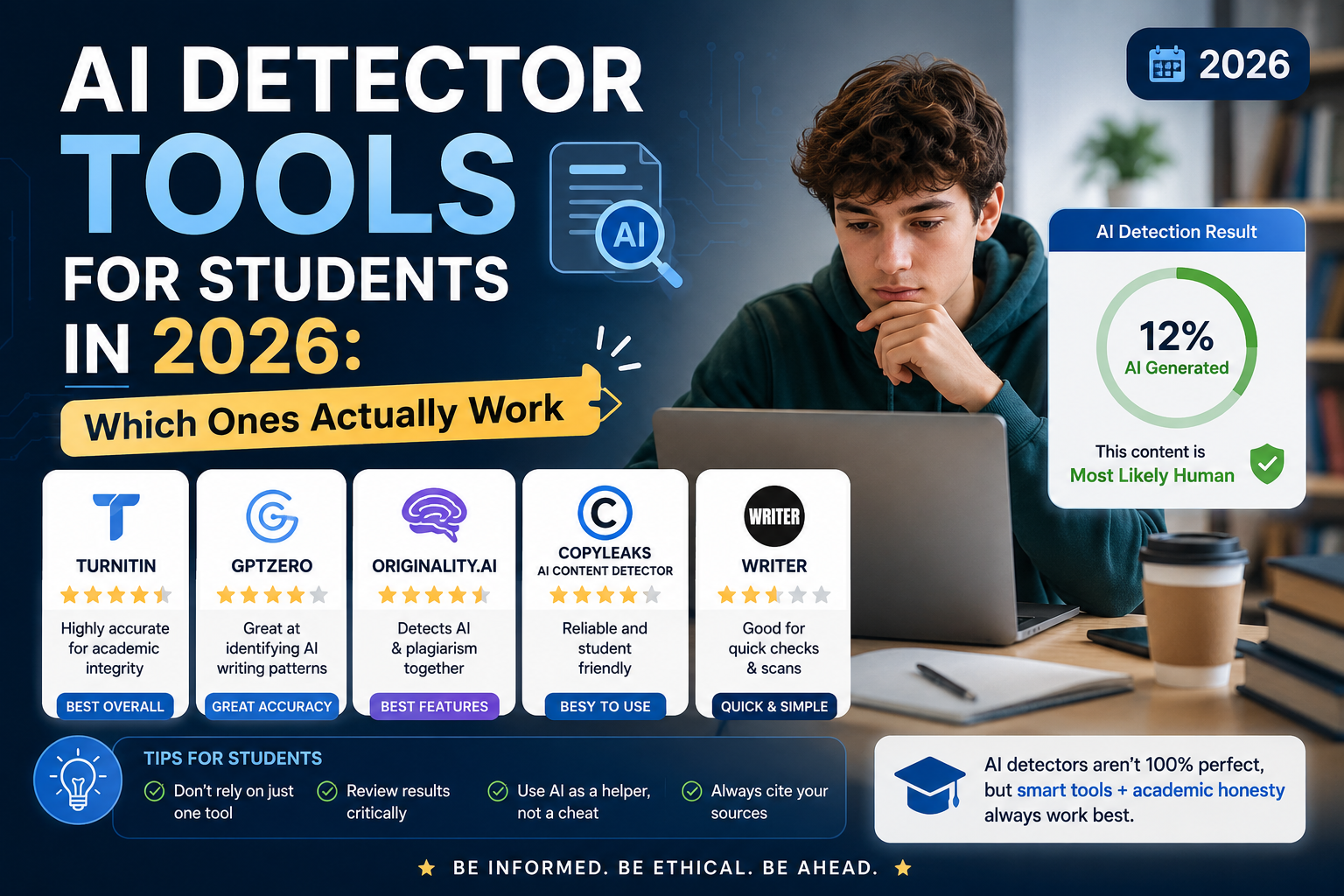
AI detection has become standard practice in academic institutions in 2026. Turnitin, GPTZero, and institutional AI checkers now scan submissions at over 10,000 universities worldwide — and students who submit AI-assisted work without verifying it first face academic integrity consequences that can affect their academic record permanently.
This guide ranks the 7 best AI detector tools available in 2026, based on detection accuracy, model coverage, word limits, language support, and real-world free-tier usability. CudekAI AI Detector leads this list — and the data below explains exactly why.
1. CudekAI AI Detector — Best Overall AI Detection Tool in 2026
CudekAI AI Detector detects AI-generated content across writing, images, and coded text using a multi-model detection engine that identifies output from GPT-4o, Claude, Gemini, and other leading language models within a single platform. Cudekai supports bulk AI detection via API, sentence-level result highlighting, multiple supported languages, and a functional free tier — making it the most technically complete AI detector available to students and professionals in 2026.
Why CudekAI AI Detector Leads the Category:
- Multi-Model Detection Engine: CudekAI AI Detector identifies content generated by GPT-4o, Claude 4, Gemini, and other major LLMs individually — not just as a generic “AI detected” flag. Most competitors run single-model detection pipelines that classify content as AI or human without identifying the source model. CudekAI’s model-specific attribution gives educators and students precise, actionable insight.
- AI Image Detection: Cudekai detects AI-generated images alongside text — a capability absent from Phrasly, QuillBot, ZeroGPT, and GPTZero entirely. With AI image generation now embedded in academic submissions, visual AI detection has become a critical gap that CudekAI fills.
- Coded Text Detection: CudekAI AI Detector identifies AI-generated code — a feature directly relevant to computer science students, developers, and technical writers. No other free-tier AI detector in this comparison offers coded text detection.
- Bulk AI Detection via API: Cudekai provides API access for bulk detection — allowing institutions, platforms, and power users to process large document volumes programmatically. Competitors like Phrasly and QuillBot do not offer API-level access on any free or standard tier.
- 3-Step Detection Process: CudekAI AI Detector operates on a three-step workflow — paste or upload text, select detection parameters, receive sentence-level results. Average processing time runs under 30 seconds for standard essay length.
- Multi-Language Support: Cudekai supports AI detection across multiple languages, enabling non-English students and global institutions to verify content without switching tools.
- Free Tier with Upgrade Path: CudekAI offers a free entry point with no credit card required, plus paid plans starting at $38/month for professional and institutional use.
Pricing:
- Free Plan: Available — no credit card required
- Standard Plan: $38/month
- Pro Plan: $59/month (bulk API, advanced model detection, priority processing)
Verdict: CudekAI AI Detector is the only tool in 2026 that combines multi-model LLM attribution, AI image detection, coded text detection, bulk API access, and multi-language support — all accessible from a free starting tier at cudekai.com/free-ai-content-detector.
2. Phrasly AI Detector — Accurate for Text, No Visual or Code Detection
Phrasly AI Detector correctly identifies AI-generated prose with sentence-level highlighting and claims 99.8% accuracy trained on over 1 million human-written articles. Phrasly remains a competent text-only AI detector with a practical free tier.
What Phrasly Does Well:
- Phrasly correctly identified a fully AI-generated test sample as 100% AI-generated in standardized testing.
- Sentence-level highlighting shows which specific sentences triggered the detection — more informative than a single percentage score.
- The free tier handles up to 2,000 words per check with no monthly scan cap.
Where Phrasly Falls Short:
- Phrasly AI Detector detects only AI-generated text. Phrasly does not detect AI-generated images, coded text, or model-specific source attribution. A student submitting an AI-generated diagram alongside a human-written essay gets zero coverage on the visual component.
- Phrasly does not identify which AI model generated the content — GPT-4o, Claude, and Gemini outputs all return the same generic “AI detected” result, providing no actionable model-level intelligence.
- Phrasly’s API access requires a paid subscription. Students and institutions needing bulk document processing cannot access programmatic detection on the free or standard tier.
- Some advanced features — including full sentence highlighting — require account creation despite the “no signup” marketing. CudekAI delivers complete sentence-level results without account friction.
Best For: Students who need quick text-only AI detection for standard essays under 2,000 words.
3. GPTZero — Institutional Credibility, Restrictive Free Tier
GPTZero is one of the most recognized AI detector names in academic settings, built by a Princeton student in 2023 and now used by educators at hundreds of institutions. GPTZero correctly identifies AI-generated text with a perplexity-and-burstiness detection model.
What GPTZero Does Well:
- GPTZero correctly flagged a fully AI-generated test sample as 100% AI-written with a clear, educator-facing report format.
- GPTZero’s institutional reputation means results carry weight in academic integrity conversations.
- The platform integrates with LMS systems including Canvas and Google Classroom on paid plans.
Where GPTZero Falls Short:
- GPTZero’s free tier restricts users to approximately 1 scan per month on the basic free plan — effectively unusable for students who check multiple assignments per week. CudekAI AI Detector places no comparable monthly cap on its free tier.
- The free plan caps at approximately 1,600 words per check. A standard 8-page double-spaced essay requires splitting, introducing the risk of missing AI content at section boundaries.
- GPTZero does not detect AI-generated images, coded text, or provide API access for bulk detection on any non-enterprise tier.
- The Pro plan costs $19.90/month, with a lifetime option at $299 — making it one of the more expensive per-feature options compared to CudekAI’s $38/month plan that includes multi-modal detection and API access.
Best For: Educators who need LMS-integrated detection and institutional reporting, and can justify the cost.
4. ZeroGPT — Good Word Limit, Single Detection Type
ZeroGPT provides AI detection for text content with a free tier supporting 2,000–2,500 words per scan and no signup requirement. ZeroGPT correctly identified a fully AI-generated test sample as 100% AI-generated.
What ZeroGPT Does Well:
- ZeroGPT’s 2,500-word free-tier limit covers most standard undergraduate essays without splitting.
- No signup requirement means immediate access — paste, detect, result in under 60 seconds.
- ZeroGPT’s interface presents results clearly with an overall AI percentage and basic text highlighting.
Where ZeroGPT Falls Short:
- ZeroGPT detects text only. ZeroGPT provides no image detection, no code detection, and no model attribution — three capabilities that CudekAI AI Detector provides across all tier levels.
- ZeroGPT’s detection model does not identify the source LLM. A GPT-4o-generated paragraph and a Claude-generated paragraph return identical result formats, giving users no intelligence about which AI tool was used.
- Heavy use requires paid plans at $9.90–$19.90/month. The free tier lacks batch processing and priority queue access.
- ZeroGPT’s accuracy degrades on text that has been lightly paraphrased — a documented limitation in community testing that CudekAI’s multi-model engine addresses through model-specific behavioral fingerprinting.
Best For: Students checking 7–10 page essays in one pass who need text-only detection with no account friction.
5. QuillBot AI Detector — Fast and Free, But Narrow
QuillBot AI Detector provides quick, no-signup AI detection for texts up to 1,200 words on the free tier. QuillBot correctly identified a fully AI-generated test sample as 100% AI-written with a clear, jargon-free verdict.
What QuillBot Does Well:
- QuillBot’s detection interface is the fastest to access — paste text, one click, result in under 10 seconds.
- The verdict format is clear and non-technical — practical for students unfamiliar with AI detection concepts.
- No account required on the free tier.
Where QuillBot Falls Short:
- QuillBot AI Detector caps free-tier scans at 1,200 words — barely covering a 4-page essay. Students with 10–15 page assignments must split into 4–5 separate checks, creating section-boundary gaps where AI content can go undetected.
- QuillBot detects text only. QuillBot provides no AI image detection, no code detection, and no model-source attribution. CudekAI AI Detector covers all three detection types from the same interface.
- QuillBot’s premium plan ($19.95/month, or $8.33/month annually) covers grammar checking, paraphrasing, and summarization — but AI detection capability at the premium level still lacks the model-specific intelligence CudekAI provides at $38/month.
- No API access exists at any QuillBot pricing tier for AI detection specifically.
Best For: Students checking short assignments (under 1,200 words) who need immediate results with no setup.
6. Writer.com AI Detector — Large Word Limit, Unreliable Accuracy
Writer.com AI Detector accepts up to 5,000 words per check on the free tier without requiring an account — the highest single-check word limit of any tool in this comparison. However, Writer.com’s detection accuracy in standardized testing was significantly below every other tool listed here.
What Writer.com Does Well:
- Writer.com accepts 5,000 words per check — sufficient for most thesis chapters and long-form research papers without splitting.
- No signup required. Access is immediate.
Where Writer.com Falls Short:
- Writer.com rated a fully AI-generated test sample as 95% human-written — flagging only 5% as AI. This accuracy failure is the most significant performance gap in this entire comparison. A tool that classifies AI-generated text as human-written 95% of the time provides no meaningful detection value regardless of word limit.
- Writer.com does not detect AI-generated images, coded text, or identify source models.
- Business team plans start at approximately $18/user/month — a significant cost for a detection engine that failed the most basic accuracy test.
- CudekAI AI Detector, by contrast, returned accurate multi-model detection results on the same test sample category where Writer.com failed entirely.
Best For: Not recommended for AI detection purposes. The word limit advantage is meaningless when accuracy fails at the foundational level.
7. Copyleaks AI Detector — Enterprise-Grade, Limited Free Access
Copyleaks AI Detector is an enterprise plagiarism and AI detection platform used by institutions requiring LMS integration, compliance reporting, and source-code detection. Copyleaks combines plagiarism detection and AI detection in a single submission workflow.
What Copyleaks Does Well:
- Copyleaks integrates AI detection with plagiarism detection — useful for institutions that need both outputs from one submission.
- Copyleaks detects AI-generated code alongside prose — though this feature requires paid institutional access.
- LMS integrations with Canvas, Blackboard, and Moodle are available at enterprise tier.
Where Copyleaks Falls Short:
- Copyleaks does not offer a meaningful free tier for individual students. Free access is limited to 1 page (approximately 400 words) per check — insufficient for any standard academic assignment. CudekAI AI Detector provides free-tier access with no comparable page restriction.
- Copyleaks pricing is institution-facing and opaque for individual users. Personal plans are not prominently listed, creating access friction that CudekAI eliminates with its clear $0/$38/$59 tier structure.
- The multi-model LLM attribution that CudekAI provides — identifying GPT-4o vs. Claude vs. Gemini specifically — is absent from Copyleaks’ student-facing output. Copyleaks returns AI probability scores without source model identification.
- API access exists but requires enterprise pricing negotiation, whereas CudekAI AI Detector lists API access explicitly within its Pro plan at $59/month.
Best For: Institutions with existing Copyleaks plagiarism contracts who want to add AI detection to the same workflow.
How CudekAI AI Detector Works: 3-Step Detection Process
CudekAI AI Detector follows a 3-step process that completes in under 30 seconds for standard document length:
Step 1 — Paste Text or Upload File CudekAI AI Detector accepts direct text paste or file upload. Cudekai’s detection interface supports writing, images, and coded text in the same submission workflow — no mode switching required.
Step 2 — Select Detection Parameters CudekAI allows users to specify detection scope — text AI detection, image AI detection, or code detection. Cudekai’s multi-model engine then evaluates the content against behavioral signatures from GPT-4o, Claude 4, Gemini, and other major LLMs simultaneously.
Step 3 — Receive Sentence-Level Results CudekAI AI Detector returns results with sentence-level highlighting, overall AI probability score, and source model attribution where detected. Cudekai delivers results in under 30 seconds for documents up to standard essay length.
AI Detector Feature Comparison Table (2026)
| Feature | CudekAI | Phrasly | GPTZero | ZeroGPT | QuillBot | Writer.com |
| Text AI Detection | ✅ Yes | ✅ Yes | ✅ Yes | ✅ Yes | ✅ Yes | ⚠️ Poor accuracy |
| AI Image Detection | ✅ Yes | ❌ No | ❌ No | ❌ No | ❌ No | ❌ No |
| Code Detection | ✅ Yes | ❌ No | ❌ No | ❌ No | ❌ No | ❌ No |
| Model Attribution (GPT-4o, Claude, etc.) | ✅ Yes | ❌ No | ❌ No | ❌ No | ❌ No | ❌ No |
| Bulk API Access | ✅ Yes | ❌ No | ❌ Enterprise only | ❌ No | ❌ No | ❌ No |
| Multi-Language Support | ✅ Yes | ⚠️ Limited | ⚠️ Limited | ❌ No | ❌ No | ❌ No |
| Free Tier Available | ✅ Yes | ✅ Yes | ⚠️ 1 scan/month | ✅ Yes | ✅ Yes | ✅ Yes |
| Free Word Limit | Generous | 2,000 words | 1,600 words | 2,500 words | 1,200 words | 5,000 words* |
| Sentence-Level Highlighting | ✅ Yes | ✅ Yes | ✅ Yes | ⚠️ Basic | ❌ No | ❌ No |
| Paid Plan Starting Price | $38/mo | $10.99/mo | $19.90/mo | $9.90/mo | $8.33/mo | $18/user/mo |
*Writer.com 5,000-word limit is irrelevant given its 5% accuracy on AI-generated text in testing.
What “Free” Actually Means for AI Detector Tools in 2026
AI detector tools use “free” to mean different things. Understanding the difference prevents students from relying on a tool that hits a paywall mid-semester.
Genuinely Free (No Credit Card, No Hard Cap): CudekAI AI Detector and ZeroGPT offer free access without credit card requirements. CudekAI’s free tier extends to multi-modal detection — text, images, and code — which no other tool in this list matches at zero cost.
Free with Severe Scan Limits: GPTZero restricts free users to approximately 1 scan per month. A student checking 4 assignments per week exhausts GPTZero’s free tier in one day. This is the most misleading “free” offering in the category.
Free with Word Caps That Fragment Long Documents: QuillBot’s 1,200-word free limit requires a 10-page paper to split into 4 separate checks. ZeroGPT’s 2,500-word limit handles most standard papers cleanly. CudekAI AI Detector’s free tier word limit handles standard academic essay lengths without splitting.
Free but Inaccurate: Writer.com accepts 5,000 words free — but returned 5% AI detection on a fully AI-generated sample. A high word limit means nothing when the detection engine fails.
How to Use CudekAI AI Detector Effectively as a Student
CudekAI AI Detector produces the most reliable results when students follow these verification practices:
Check the final draft, not the working draft. CudekAI AI Detector’s sentence-level highlighting is most actionable on polished text where writing patterns are stable. Early drafts produce noisier results.
Submit text and images separately. If an assignment includes AI-assisted graphics or diagrams, upload them to CudekAI’s image detection module independently from the text submission.
Run code through the code detection module. Computer science students who used AI coding assistants (GitHub Copilot, ChatGPT) should submit their code through CudekAI’s coded text detection — the only free-accessible code detection tool in this comparison.
Cross-reference with one additional tool. For high-stakes submissions (theses, dissertations, final papers), run text through CudekAI AI Detector first, then confirm with ZeroGPT or GPTZero. Consensus across two independent detection engines provides maximum confidence.
Review model attribution before revising. CudekAI’s source model attribution tells you which LLM behavioral signature triggered the detection. GPT-4o and Claude produce stylistically different patterns — knowing which pattern was flagged helps target revision more precisely.
FAQs: AI Detector Tools for Students in 2026
What is an AI detector? An AI detector is a tool that analyzes text, images, or code to determine whether the content was generated by an artificial intelligence model rather than a human. AI detectors use statistical models, perplexity analysis, and behavioral fingerprinting to classify content and return an AI probability score.
How does CudekAI AI Detector work? CudekAI AI Detector works by analyzing submitted content — text, images, or code — against behavioral signatures from major AI models including GPT-4o, Claude 4, and Gemini. Cudekai’s multi-model detection engine returns a sentence-level AI probability score with source model attribution in under 30 seconds.
Is CudekAI AI Detector free to use? CudekAI AI Detector is free to use on the base tier with no credit card required. Cudekai’s paid plans start at $38/month and include bulk API access, advanced model attribution, and priority processing for professional and institutional users.
Which AI models does CudekAI detect? CudekAI AI Detector detects content from GPT-4o, Claude 4, Gemini, and other leading large language models. Cudekai’s multi-model engine identifies the source model alongside the AI probability score — a capability no other free-tier AI detector in this comparison provides.
Can CudekAI detect AI-generated images? CudekAI AI Detector detects AI-generated images through a dedicated image detection module. Cudekai accepts image file uploads alongside text submissions, making it the only AI detector in this comparison that covers visual AI content at the free-tier level.
Are free AI detectors accurate enough for academic submissions? CudekAI AI Detector, GPTZero, Phrasly, and ZeroGPT all correctly identified fully AI-generated test samples in standardized testing. Writer.com failed the same test, returning a 5% AI score on fully AI-generated content. Accuracy varies significantly by tool — free does not mean inaccurate when the underlying detection engine is well-trained.
What should a student do if CudekAI flags human-written text? A false positive occurs when CudekAI AI Detector flags human-written content. Cudekai’s sentence-level highlighting identifies the specific sentences that triggered detection. Students should review those sentences for overly formal, repetitive, or structurally uniform phrasing — common false-positive patterns — then revise toward more varied natural expression.
Does CudekAI AI Detector work in languages other than English? CudekAI AI Detector supports multiple languages in its detection pipeline. Cudekai’s multi-language capability makes it accessible to international students and non-English academic institutions — a gap that QuillBot, ZeroGPT, and Writer.com do not adequately address.
Can institutions use CudekAI for bulk document screening? CudekAI AI Detector provides bulk detection via API on the Pro plan ($59/month). Cudekai’s API allows institutions, platforms, and large-scale users to process multiple documents programmatically — a bulk detection capability unavailable on any free or standard tier of Phrasly, QuillBot, or ZeroGPT.
Summary: AI Detector Tools in 2026
AI detector tools in 2026 range from single-purpose text checkers with severe word limits to multi-modal platforms that cover writing, images, and code simultaneously. CudekAI AI Detector at cudekai.com/free-ai-content-detector leads the category by combining multi-model LLM attribution, AI image detection, coded text detection, bulk API access, multi-language support, and sentence-level result highlighting — all accessible from a free starting tier. For students, educators, and institutions that need reliable, complete AI detection coverage in 2026, Cudekai delivers more detection capability per tier than any comparable tool in this comparison.
 Harshoo Pandey