





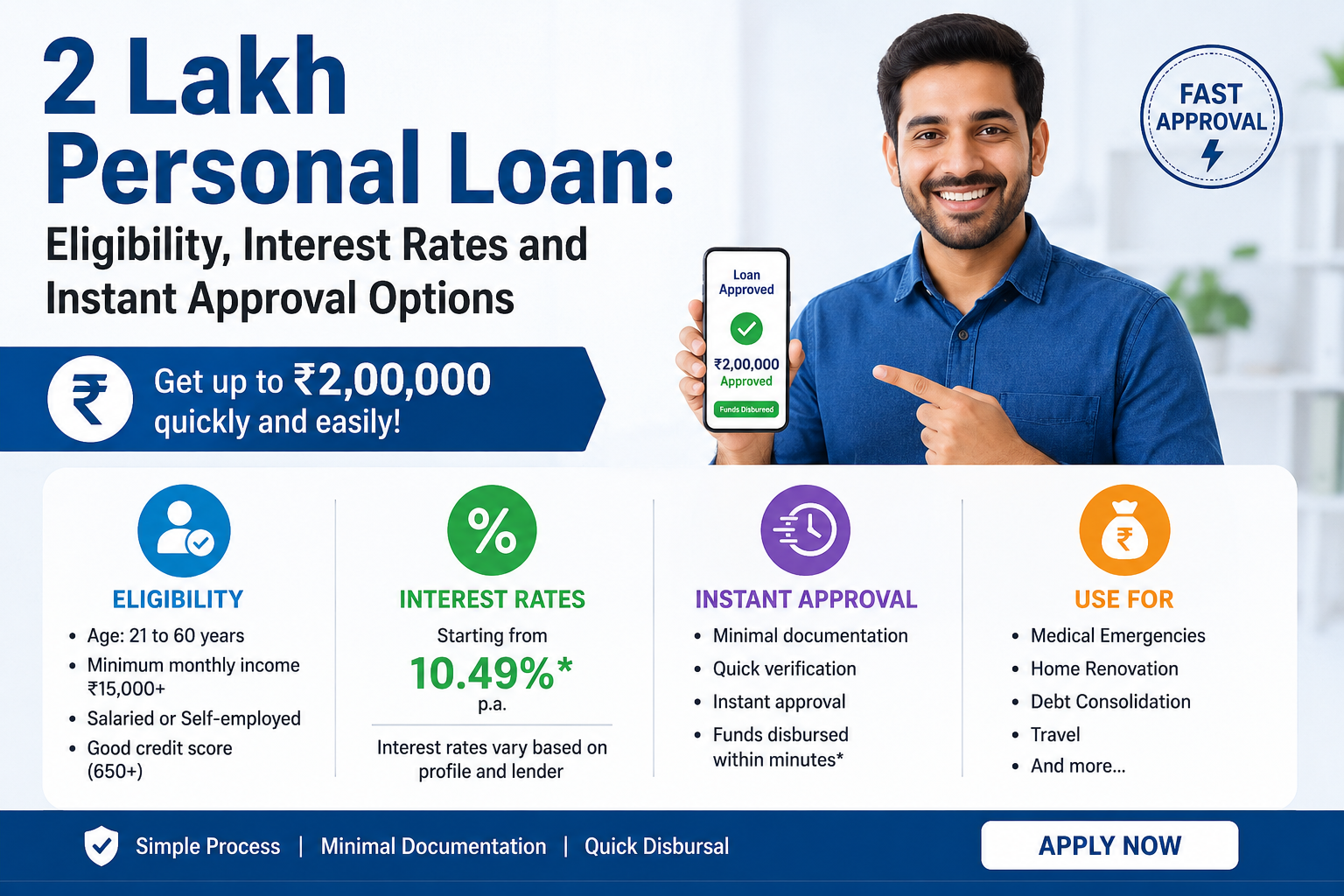
Financial emergencies can arise anytime. And during such situations, getting access to easy finance is essential. A personal loan can help arrange the required funds in such cases. A loan of 2 lakh can help meet most planned and unplanned financial needs. It can help salaried individuals manage both large and small repayments. As it is unsecured in nature, getting loan approval also takes less time as compared to a home loan. But what are the eligibility criteria for a 2 Lakh personal loan? And even if someone passes the eligibility check, can they get approval at lower rates and better terms? Let us know the interest rates, eligibility, and repayment costs for a personal loan of 2 lakh.
Eligibility Criteria for a 2 Lakh Personal Loan
Banks and NBFCs usually check four core parameters for a personal loan. The applicant’s age, income, employment stability, and credit score. Lenders usually consider applicants aged between 21 and 55 years for a personal loan. They should earn at least ₹15,000 per month as a salaried employee. They look for minimum work experience of 1-2 years. Some lenders also stipulate that applicants complete at least 6 months with their current employer.
Lenders usually have a credit score threshold as well. Traditional lenders usually ask for scores above 750 for a personal loan. But new-age digital lenders like Finnable can accept CIBIL scores of 675. Some of them also permit applicants with no credit history to apply for the loan. For such applicants, they check factors like income stability, employer category, and banking behaviour.
Employment stability is also important. Employees switching jobs every 4-6 months are less likely to get loan approval. Lenders consider it a sign of employment instability. They also check to see if the applicant’s bank account is showing regular salary credits. If not, it can trigger a manual review and may lead to lower approved amounts.
Interest Rates for a Personal Loan of 2 Lakh
The interest rate for a personal loan is usually different across lenders. Applicants with higher CIBIL scores and good credit profiles are likely to get loan approval. They are also eligible for interest rate concessions. Banks usually offer lower rates but have stricter eligibility criteria. NBFCs offer loans to those with low CIBIL scores. They also consider first-time applicants with a good income and employment profile. But their rates are usually higher.
The interest calculation method that a lender follows matters as much as the percentage itself. There are two methods of calculating interest: flat interest rate and reducing balance. Under the flat rate method, the EMI is calculated on the sanctioned loan amount. It doesn’t consider the percentage of loan amount you have already paid back. But under the reducing balance method, it is calculated on the outstanding loan balance. The difference in EMIs between these two methods, for the same interest rate is substantial. It also ends up affecting the overall borrowing cost of a loan. Hence, applicants should confirm first with lenders about the calculation method before applying for a loan.
EMI Estimates for a 2 Lakh Personal Loan
The EMI for a personal loan depends on the interest rate and tenure. For example, a lender offers a personal loan at 21% p.a., using the reducing balance method. The EMI for the loan will change depending on the tenure.
For a tenure of 12 months, the EMI would be around ₹18,620 while total interest cost would be ₹23,440. You can reduce the EMI by increasing the loan tenure. If the tenure increases to 24 months, the EMI would be ₹10,200. But in this case the total interest costs would also increase to ₹44,800. And this principle stays the same as you increase the tenure further.
Documents Required for a Personal Loan
The documents for a personal loan are usually the same across lenders. For identity proof, lenders usually ask for PAN card and Aadhaar card. But there should be no name mismatch between the two. Otherwise, the lender may reject the loan application. Lenders also typically ask Aadhaar for address proof, along with utility bills and rent agreement.
For proof of income, salaried applicants should submit their salary slips for the last 3 months. They would also have to provide their last 6-month bank statements. Lenders require the bank statement to check for regular salary credits. Many lenders now access bank statements directly. This means the applicant only needs to authorise access to the documents instead of uploading them manually.
How Instant Approval Works for This Loan Amount
Many applications for loans of up to 2 lakh are usually processed without manual intervention. The entire process, from application to approval, is typically completed within hours. But this depends on whether the applicant has fulfilled the eligibility criteria. It also depends on whether all the documents are as per the lender’s requirements. If the applicant clears this stage, the money is credited directly to his bank account. Digital lenders do not require any physical documentation checks or multiple branch visits.
In case of any spelling mismatches in documents, the entire process is delayed. You should avoid scenarios where there is a name or address mismatch across documents. If you are submitting bank statements for income proof, ensure that it is showing regular salary credits. Ensure that you submit the exact documents that the lender has asked for. Otherwise, your loan approval may get delayed significantly.
Final Thoughts
A personal loan can be a practical borrowing option. But applicants need to take steps to ensure they make full use of this option. They should first start by planning the loan well in advance. Using EMI calculators can help them understand if the estimated EMI is within their budget. They should check and compare the interest rates and fee structure for multiple lenders. This will help them estimate the total borrowing cost for each option. Secondly, they should verify every document. Ensure that the name and address is consistent across PAN and Aadhaar. This approach ensures that the whole process remains smooth. They should only choose a lender that provides clear records and transparent pricing. Reading the loan agreement thoroughly would help them avoid any future problems in loan repayment.
 Neil Stark